ISI, Rootindexing, Index Copernicus, SOBIAD
2023-06-22
Our journal is indexed in the national and international directories such as ISI, Rootindexing, Copernicus, SOBIAD...
Read more about ISI, Rootindexing, Index Copernicus, SOBIADIJESOS is an open-access academic journal published biannually in the fields of education and social sciences. A double-blind peer review process is applied. For a manuscript to be accepted, the similarity index must not exceed 20%. However, higher similarity rates may be accepted as exceptions for book reviews, translations, or similar works, provided that appropriate references are clearly indicated. The submission of the plagiarism report and responsibility for the similarity rate rest with the author. In manuscripts submitted to IJESOS, artificial intelligence tools may be used only for language editing, translation, and formal improvement. The manner in which AI tools are used must be clearly disclosed within the manuscript. Manuscripts submitted to IJESOS must not have been previously published or be under consideration elsewhere. Upon submission, the publication and copyright rights are transferred to IJESOS, and no financial compensation or other privileges may be claimed. All publications may be used by anyone, provided that proper attribution is given to both IJESOS and the author.
Our journal is indexed in the national and international directories such as ISI, Rootindexing, Copernicus, SOBIAD...
Read more about ISI, Rootindexing, Index Copernicus, SOBIAD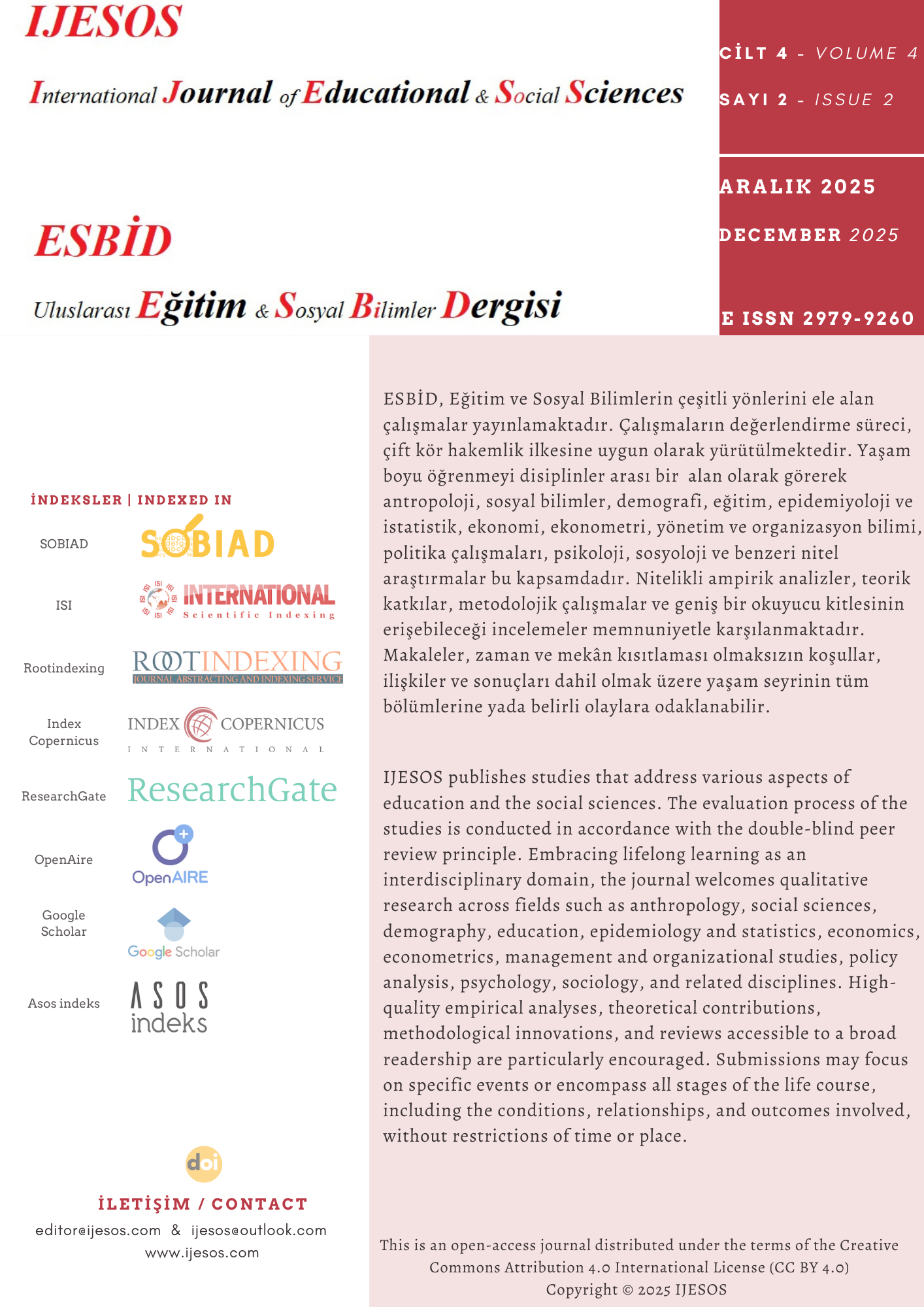
IJESOS publishes studies that explore diverse dimensions of Education and Social Sciences. Conceptualizing lifelong learning as an interdisciplinary domain, the journal’s scope extends to anthropology, social sciences, demography, education, linguistics, translation studies, epidemiology and statistics, gerontology, economics, econometrics, management and organization, policy studies, psychology, and sociology. We welcome high-quality empirical analyses, theoretical contributions, methodological innovations, and reviews accessible to a broad readership. Submissions may focus on specific events or encompass all stages of the life course—including associated conditions, relationships, and outcomes—irrespective of temporal or spatial constraints.
 Abstract views: 225
/
Abstract views: 225
/  PDF downloads: 81
Abstract views: 272
/ PDF downloads: 128
Abstract views: 379
/ PDF downloads: 206
Abstract views: 284
/ PDF downloads: 95
Abstract views: 225
/ PDF downloads: 88
Abstract views: 143
/ PDF downloads: 104
Abstract views: 402
/ PDF downloads: 189
Abstract views: 169
/ PDF downloads: 73
Abstract views: 316
/ PDF downloads: 133
Abstract views: 144
/ PDF downloads: 92
PDF downloads: 81
Abstract views: 272
/ PDF downloads: 128
Abstract views: 379
/ PDF downloads: 206
Abstract views: 284
/ PDF downloads: 95
Abstract views: 225
/ PDF downloads: 88
Abstract views: 143
/ PDF downloads: 104
Abstract views: 402
/ PDF downloads: 189
Abstract views: 169
/ PDF downloads: 73
Abstract views: 316
/ PDF downloads: 133
Abstract views: 144
/ PDF downloads: 92

The journal is licensed under a Attribution 4.0 International (CC BY 4.0).
Journal Hosting, Support, and Customization by | OJSDergi.com